

Guides What drives value
How Luxury Watch Valuation Works, and Why Quotes Differ
A luxury watch is valued on four things: the specific reference, its condition, what paperwork comes with it, and what that reference is currently doing in the resale market. Two honest buyers can land thousands apart because they sell to different customers, carry different overheads, and hold inventory for different lengths of time. A quote is only comparable when you know which reference it was quoted against and what condition it assumed.
Sellers usually assume valuation is a lookup: find the model, read the price. It is closer to an appraisal of a used car, where the same model year can be worth double or half depending on specifics, except the specifics on a watch are smaller and harder to see.
The four inputs
1. The reference, not the model
The model name is a family. The reference is the watch. A Submariner might be a 16610, a 114060, a 126610LN or a dozen others, built across different decades with different movements, bracelets and case profiles, and they do not trade at the same number. Every serious conversation starts with the reference engraved between the lugs at 12 o’clock.
2. Condition, described honestly
Condition is not a single grade. A buyer looks at the dial and hands for damage or refinishing, the case for sharpness at the lug edges, the bezel for fading or replacement, the bracelet for stretch, and the crystal for scratches or a replacement. Original and honest beats restored, which surprises people: a watch with soft, over-polished lugs is worth less than the same watch with its factory edges and a few visible scratches.
3. What comes with it
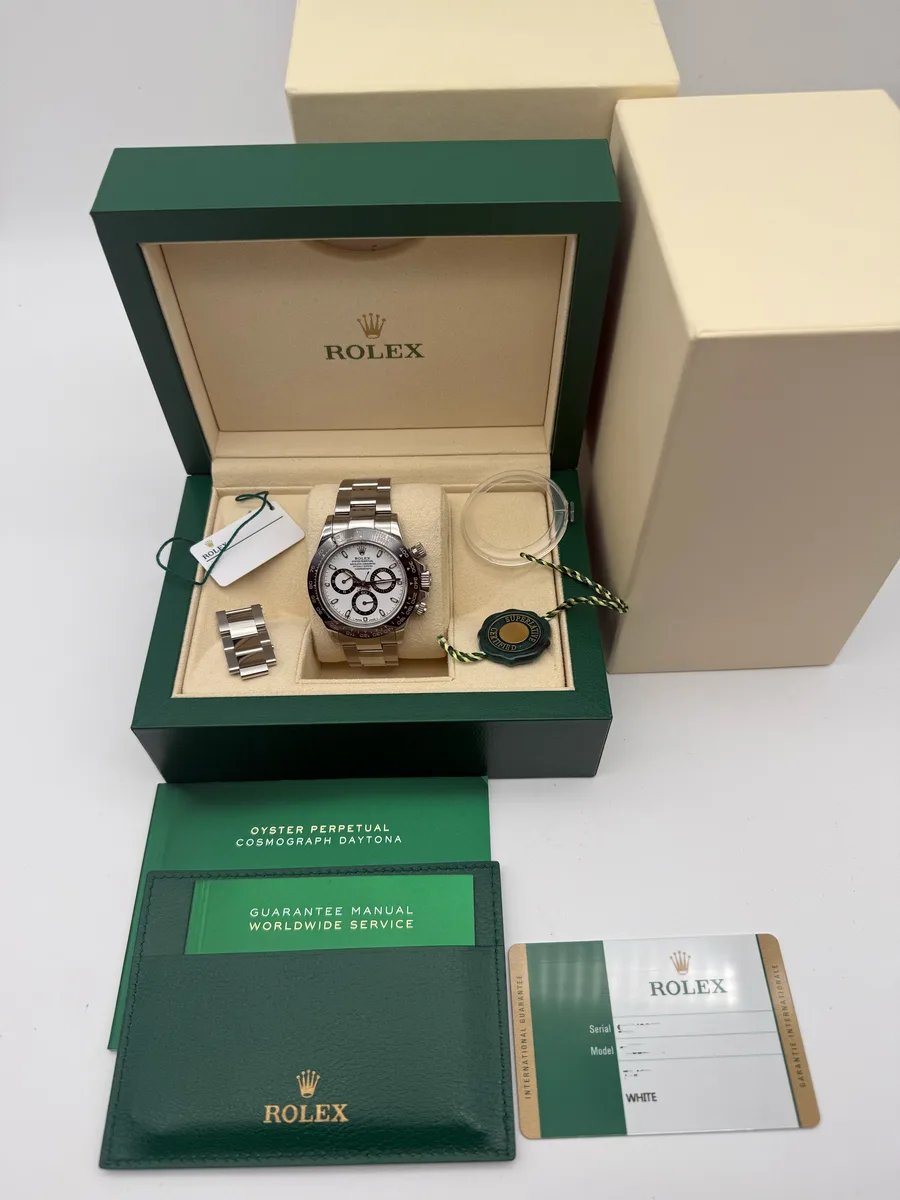
A matching warranty card, the original box, the booklets, and service invoices from an authorized center all move the number. The effect is largest on modern references, where a complete set is the market expectation, and smaller on vintage, where originality of the watch itself carries more weight than the cardboard.
4. Where that reference is in the market right now
Resale values move. A reference that has just been discontinued can firm up; one that has just been replaced by a better version can soften. Demand is also seasonal and regional. This is the input a seller cannot see and the buyer deals with daily, and it is the honest reason a quote has a shelf life.
Why two honest offers differ
| Buyer type | Who they resell to | Why the number lands where it does |
|---|---|---|
| Specialist watch buyer | Collectors and dealers | Knows the reference, prices the specifics, carries the resale risk |
| General jeweler | Walk-in retail | May price nearer a generic used rate if watches are not their trade |
| Pawnshop | Whoever walks in | Prices for a fast exit and a wide margin, lowest of the three |
| Gold or scrap buyer | Refiners | Prices the metal and ignores the watch, which can be a fraction of its worth |
That table is the single most useful thing to understand before you start making calls. The spread between the top and the bottom row on a steel sports Rolex is not a haggling margin. It is the difference between selling a watch and selling its materials.
How to read a quote properly
- Which reference was it quoted against. If nobody asked, it was not quoted against yours.
- What condition does it assume, and what would change it at inspection.
- Is it firm, subject to inspection, or an indication only.
- How long is it valid for.
- How and when are you paid, and who insures the watch in the meantime.
A buyer who can answer all five in writing is quoting. A buyer who will only give a number on the phone and wants the watch in the building is prospecting.
Compare quotes on what they assume, not just on what they say.
Getting a number from WatchCash
Send the reference and photographs and you get a written range against your exact watch, with the reasoning. If the watch turns out to be better than the photographs suggested, the number goes up at inspection; if something was missed, we say what and why. The main US location is 110 E Broward Blvd #1700 in downtown Fort Lauderdale, by appointment.
Common questions
Why do watch buyers quote such different prices?
Because they resell to different customers and carry different costs. A specialist pricing your exact reference for a collector market will normally beat a general jeweler or a pawnshop, and a scrap buyer may price only the metal, which can be a fraction of the watch’s worth.
Is my insurance appraisal what my watch is worth?
No. An insurance appraisal states replacement cost at retail, which is normally well above any resale offer. It is useful evidence of value for a claim, not a price a buyer will pay.
Does a service history increase value?
Documented service from an authorized center helps, particularly on older references where a buyer is otherwise guessing at the movement’s condition. Undocumented work by an unknown watchmaker can reduce value if non-original parts were fitted.
How long is a valuation good for?
Resale values move, so a responsible quote states how long it stands. Ask. A number with no expiry date is usually an indication rather than an offer.
Ready to sell?
Get a free, no-obligation valuation. We value your exact reference and explain how we reached the number.
Get your free quote